
Do Mobile Markets Actually Work? What the Research Shows
Funders ask it. Board members ask it. Skeptical stakeholders ask it. The question deserves a straight answer: what does the evidence actually say about mobile market effectiveness?
Short version: mobile markets reliably improve fresh food access and increase produce consumption in communities they serve. Health outcome evidence is promising but less definitive. They're not a silver bullet, but they work for what they're designed to do.
What We Know with Confidence
Mobile grocery stores increase food access in underserved areas. This is definitionally true and well-documented. When a mobile market starts serving a neighborhood without nearby grocery options, residents gain access they didn't have before. Studies consistently show increased availability of fresh produce in communities with mobile market programs.
Mobile markets reach food-insecure populations. SNAP/EBT redemption rates at mobile markets indicate they're serving customers who rely on food assistance. Customer demographic data from multiple programs shows that mobile markets reach populations that don't typically shop at farmers markets. Lower-income. Less mobile. More racially diverse.
Regular mobile market customers increase produce consumption. Survey-based studies consistently find that frequent mobile market shoppers report eating more fruits and vegetables than before the market was available. Self-reported data has limitations, but the pattern is consistent across multiple programs.
What the Evidence Suggests
Health improvements are associated with mobile market programs, though causation is harder to establish.
Hospital-based programs
Hospital-based programs that track patient populations have documented improvements in diet-related biomarkers; including blood pressure, blood glucose, and cholesterol among mobile market participants. While these encouraging results typically stem from observational studies rather than randomized trials, they highlight the significant health potential of community-driven food access.
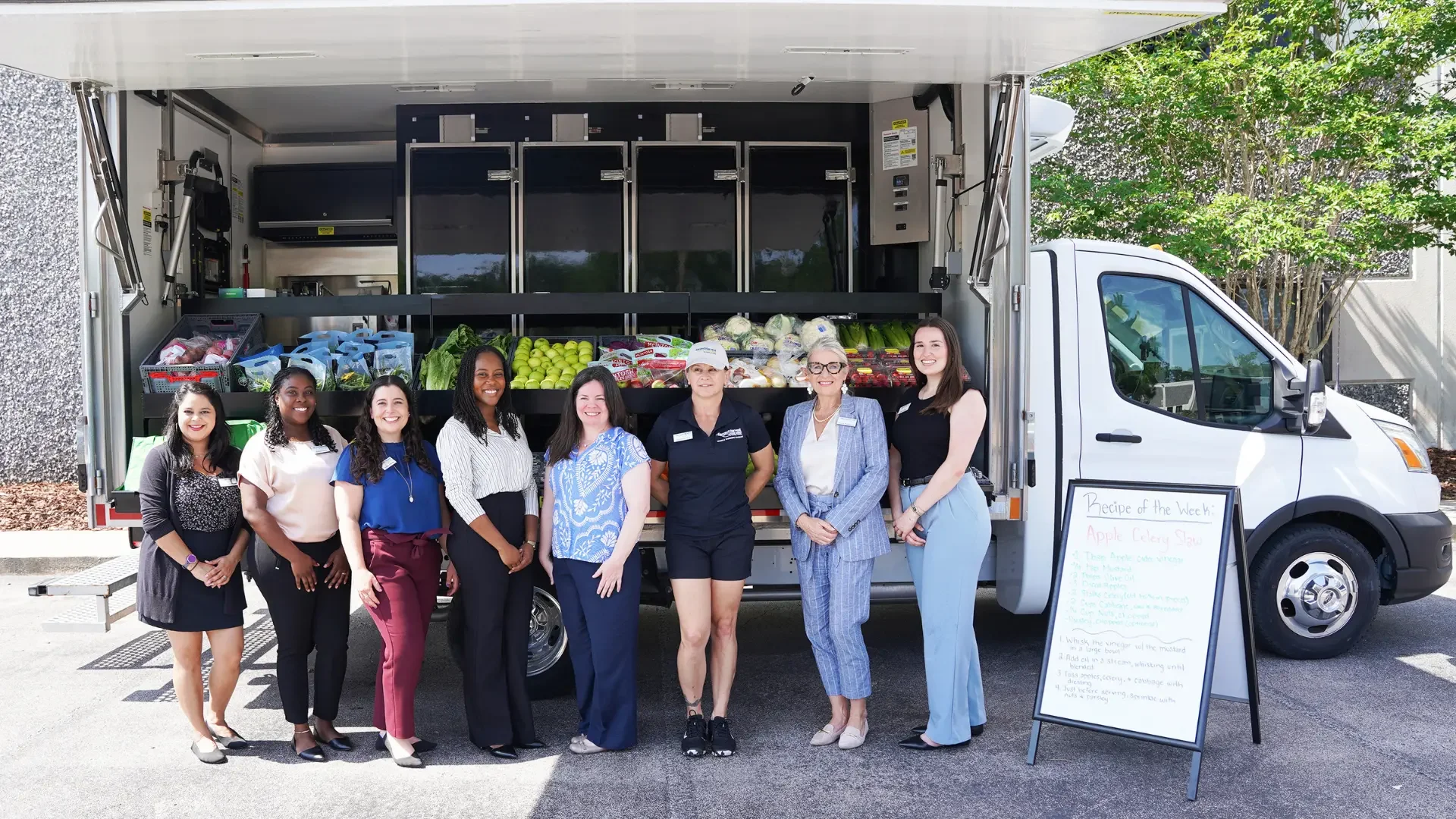
A prime example of this model in action is the partnership between Mass General Brigham (MGB) and the YMCA of Greater Boston. Supported by a $3 million multi-year investment from Mass General Brigham, the collaboration operates the Greater Boston Collaborative Food Access Hub in Roxbury. This centralized facility powers mobile markets that deliver fresh produce and recovered food to high-need neighborhoods, directly integrating healthcare-led investment with local food distribution to improve long-term health outcomes.
Produce prescription programs, where patients receive vouchers redeemable at mobile markets, have stronger evidence. Multiple studies show that produce Rx participants increase fruit and vegetable consumption and, in some cases, show improved clinical markers. The mobile market is the access point. The evidence suggests the intervention works.
Community-level effects are reported but difficult to quantify. Programs describe mobile markets becoming community gathering points, improving social connection, and serving as platforms for health education and other services. These effects are real but resist standardized measurement.
What We Don't Know
Long-term health outcomes lack definitive evidence. Does sustained mobile market access reduce diabetes incidence, cardiovascular events, or healthcare utilization over years? We don't have large-scale longitudinal studies to answer this. The logical chain makes sense. Better food access leads to better diet leads to better health. But we can't point to definitive proof of the full chain.
Cost-effectiveness compared to other interventions isn't well-established. Is a dollar spent on mobile markets more effective than a dollar spent on produce prescriptions through existing retailers? Or nutrition education? Or other food desert solutions? We lack rigorous comparative studies.
Optimal program design remains uncertain. What's the ideal stop frequency, location selection, product mix, or pricing strategy? Programs vary widely. We don't have definitive evidence on which approaches work best.
Limitations of the Evidence
Most mobile market research comes from program evaluations, not independent studies. Organizations evaluating their own programs have incentives to find positive results. Publication bias may mean negative findings go unreported.
Self-reported dietary data is imperfect. People may overstate their vegetable consumption, especially when they know they're being studied. Objective measures like biomarkers or food purchase tracking are harder to collect but more reliable.
Generalizability is uncertain. A program that works in one community may not work in another with different demographics, geography, or food culture. Results from urban programs may not apply to rural settings, and vice versa.
Putting It in Context
Mobile markets are a practical intervention, not a research experiment. They exist because communities need fresh food access, and they demonstrably provide it. The evidence bar for 'does this help?' is different from the evidence bar for 'can we publish this in a peer-reviewed journal.'
By the practical standard, mobile markets work. They bring food to people who need it. Those people buy and eat the food. There's good reason to believe health benefits follow.
Perfect evidence? No. Sufficient evidence to justify continued investment? Yes.
The comparison shouldn't be mobile markets versus some ideal, perfectly-proven intervention. The comparison is mobile markets versus nothing. Versus communities continuing to lack food access. On that comparison, the evidence clearly favors action.
For Funders and Skeptics
If you're evaluating whether to fund a mobile market program, reasonable expectations include documented increases in food access for the target area, measurable participation by food-insecure customers (SNAP redemption is a good proxy), and evidence of repeat customer behavior indicating the service meets a real need.
Unreasonable expectations include definitive proof of long-term health outcomes, cost-effectiveness calculations with precise ROI, or evidence that mobile markets alone will solve food insecurity. That's not what any food access intervention can deliver.
The question isn't whether mobile markets are a perfect solution. It's whether they're a worthwhile intervention given available alternatives.
The evidence says yes.
For more on mobile market basics, see: What Is a Mobile Market?
