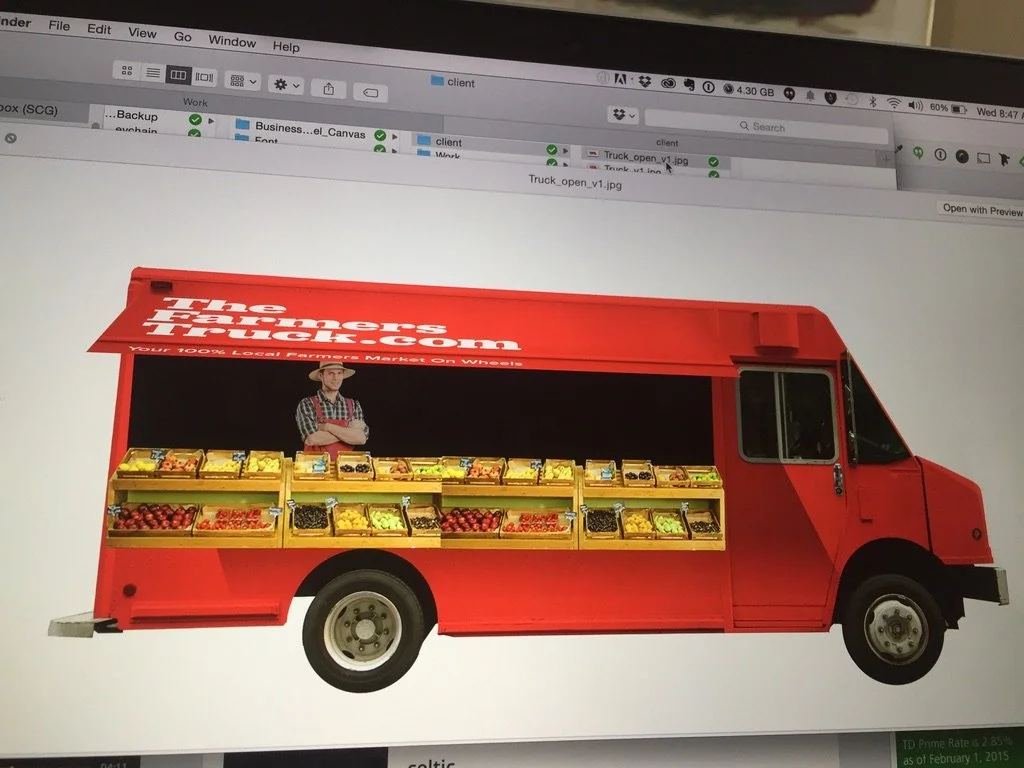
April 1st, 2015. First rendering of the Farmers' Truck.It started as a logo project.
A civil engineer with an MBA had bought a small farm in Cap-Pelé, NB.
I met Mathieu at an event. He had just bought a farm near the coast, he was growing food and planning to make products, and I came on to work on his branding, his marketing, his packaging.
I grew up on a farm. I watched my father work day in, day out, tirelessly. So when I met someone who had left engineering to take that on by choice, I paid attention. I wanted to build something with him.
The packaging was not the problem.
He had no real way to sell what he grew. Farmers’ markets around had long waitlists. Grocery chains were not interested in his volume.
So we stopped designing labels and built a truck.
We ran it ourselves from 2015 to 2018.
Two trucks and an online store. We were the operator, not the supplier.
That is where the story turned. The people who kept showing up were not the customers we had designed for. They lived in neighborhoods where the grocery store had closed. No car, or no store within a bus ride. They were not looking for local artisanal products. They wanted produce at a price they could pay, close to home.
We built a retail channel for one farm. What we had actually built was a way to get fresh food into places the grocery industry had written off.
Then we hit something we could not design around.
We were not bad at selling produce. In fact, from June to early September the trucks did very well. Then the season ended and we bled until the next June.
That is not a problem unique to us. That is what a mobile market looks like in a northern climate. This work has to be subsidized or structured differently, delivered differently, and we had decided at the start that we did not want to live on grants. We wanted the program to pay for itself and pay farmers properly at the same time.
Those are two good goals. They also fight each other.
For the people we were serving, price was the number one barrier. For a small farm, wholesale barely covers the cost of growing. Everything costs more at small scale, which is why most small farmers want to sell direct and keep the whole margin. We were asking them to take less so we could charge less.
At our volume, that does not square. Not without support.
So in 2019 we pivoted to where the support already exists.
Food banks, health systems, community groups. Organizations funded to do this work, who do not need the market to turn a profit.
They had been calling us the whole time anyway. Not about the program. About our truck. We sold one which is still operating today, and it was obvious where we could actually help. Most of them were retrofitting a used step van and hoping. We knew how that goes, because we had already done it.
What we could actually fix
Setting up tables and tents in a parking lot is exhausting, and all of it happens before the first customer shows up.
Our design means a two-person crew arrives and is serving in minutes. Every decision we make now answers the same question. Does this make the day easier for the person running the market?
The truck is on its seventh version.
Version one taught us we did not understand the industry that builds these bodies. Then came health codes, which change state to state and decide what you are allowed to sell out of a vehicle. Then a few hundred smaller things like where the handle sits.
None of that came from a drawing. It came from our experience and operators telling us what was not working, and from us going back and fixing it.
The truck gets better with time. That’s by design.
Frederic Laforge
Co-Founder & CEO
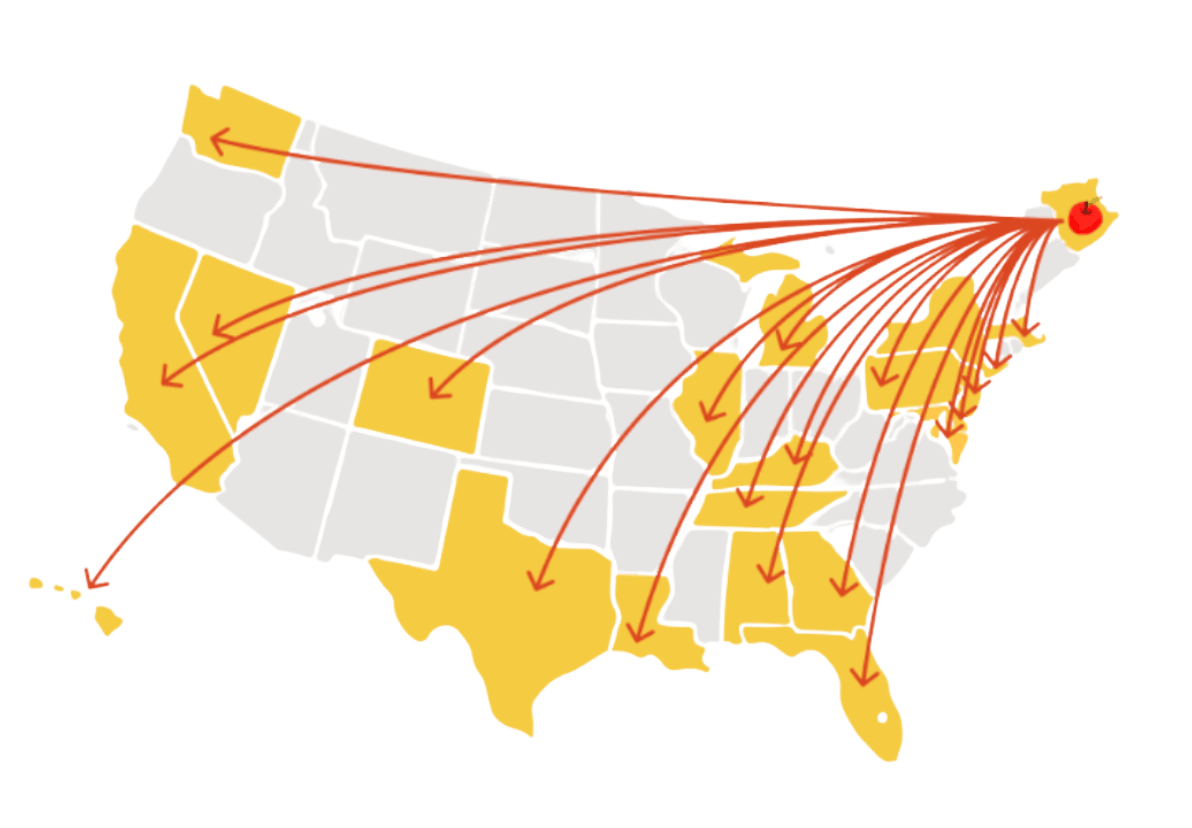
Programs in 23 states, serving an estimated 25,000 families a week.
We sell the truck. We also hand over the Handbook. Routes, pricing, staffing, funding. The things that took us three years on the street to work out. The truck is the easy part.
Tell us what you are trying to build. We will tell you what it takes.
Today