
The Mobile Grocery Store Model: A Channel for Grocers, Food Hubs, and Farmers
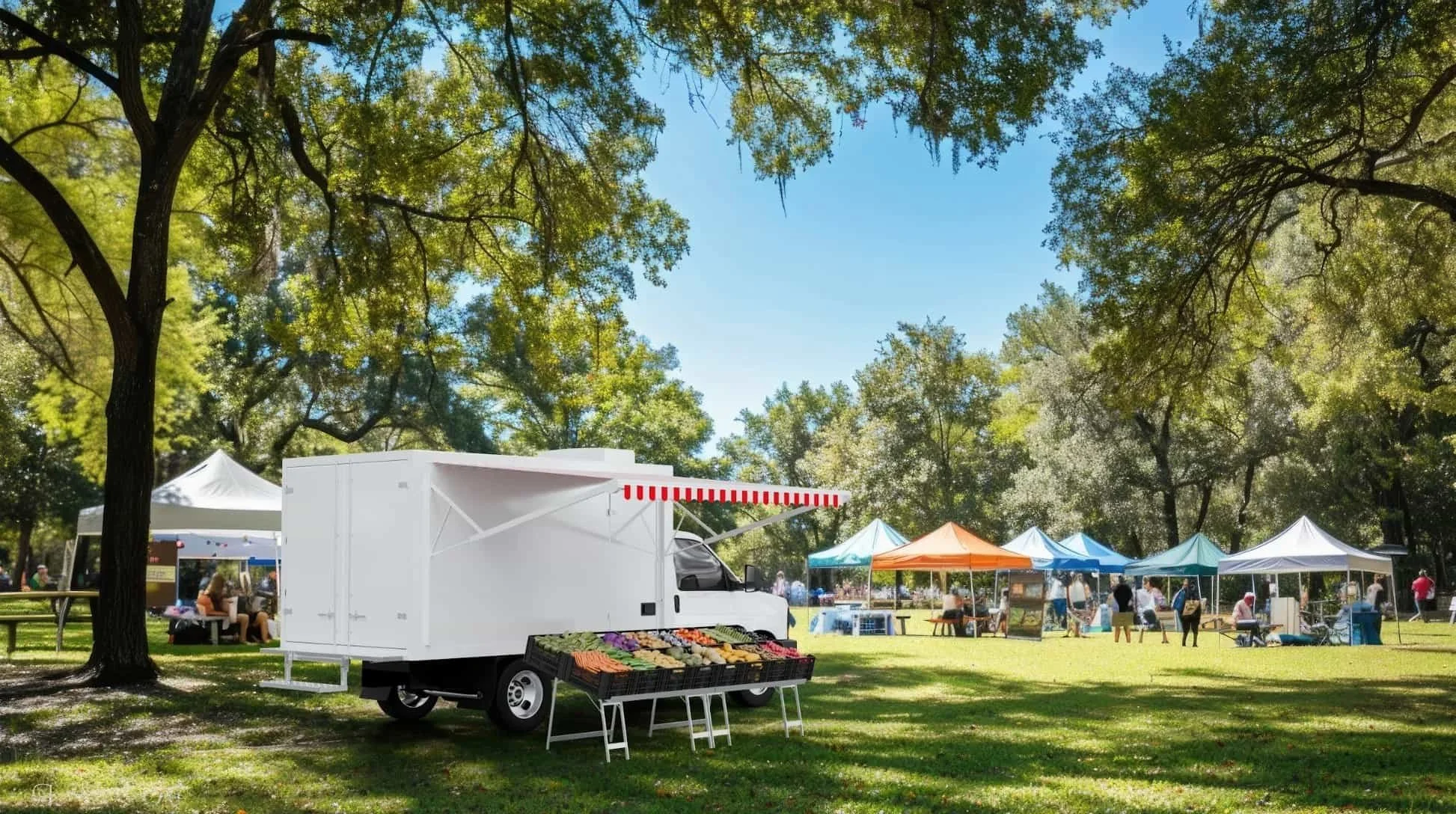
Most mobile markets are run by nonprofits and health systems pursuing food access missions. But the mobile market model can also work commercially. For grocers, food hubs, and farmers, it's a way to reach customers in areas where traditional retail doesn't pencil out.
This guide looks at mobile markets from a business angle: when the model fits commercial operators, what the economics actually look like, and how it compares to other distribution channels.
Why Commercial Operators Are Exploring Mobile Markets
Traditional grocery economics have left real gaps. Small towns lose stores when margins can't cover overhead. Urban neighborhoods become food deserts when demographics don't attract investment. Rural areas lack population density to justify brick-and-mortar locations.
These gaps represent unserved demand. People would buy groceries if someone made them available.
A mobile market can serve these communities without fixed-location costs. A truck visits multiple underserved areas on rotation, combining demand across locations that couldn't individually support a store. The math that fails for a brick-and-mortar location sometimes works for a vehicle.
Regional grocers can extend reach into areas adjacent to existing stores. Rather than building a new location with its multi-million dollar investment, a mobile unit can test demand and serve outlying communities.
Food hubs and aggregators can capture retail margins on products they already handle since wholesale distribution is their core business. A mobile market adds a consumer channel without requiring additional retail real estate.
Farmer cooperatives can pool resources that individual farms couldn't afford. A single farm can't justify a $200,000 truck. Ten farms together might.
How the Commercial Model Differs
Commercial mobile markets operate differently from mission-driven programs.
Revenue must generate margins. Nonprofit programs often sell at or below cost with grant subsidies. Commercial operators need pricing that covers expenses and produces returns. Expect retail-competitive prices. The value proposition is convenience and access, not low cost.
Product mix may emphasize higher-margin items. Fresh produce remains central, but dairy, eggs, prepared foods, and pantry staples often have better margins. The selection balances customer needs with economic sustainability.
The customer base includes both food-insecure populations and convenience shoppers. You'll serve people who genuinely lack alternatives. You'll also serve people with cars who simply prefer not to drive or want to shop locally. Don't assume every customer is driven by necessity.
Scale affects profitability significantly. A single vehicle is hard to make profitable with f. Fixed costs spread over limited sales. Multiple vehicles achieve better economies of scale economics by distributing overhead across more revenue.
Comparison to Other Channels
Understanding where mobile markets fit helps clarify their role.
Compared to farmers markets, mobile markets offer more control. You choose locations and schedules instead of following market rules. You don't compete side-by-side with other vendors. But you lose built-in foot traffic and carry the full marketing load.
Compared to grocery delivery, mobile markets preserve the in-person shopping experience. Customers see and select their own produce. No minimum orders, no delivery fees, or apps required. But you must show up physically, limiting geographic reach.
Compared to opening a new retail store, mobile markets require far less capital and commitment. A truck costs a fraction of a building and can be redeployed if locations underperform. But a truck can't match a store's selection or hours.
Mobile grocery stores work best as complements to other channels, not replacements. They fill gaps that other approaches can't efficiently serve.
Real Economics
Most single-vehicle commercial mobile markets struggle to achieve profitability. The economics are challenging.
Revenue potential depends on stops, customers, and transaction size. A program making 15 stops weekly, averaging 25 customers at $20 each, generates roughly $7,500 weekly or $375,000 annually.
Cost of goods typically runs 50 to 65 percent for grocery items, leaving 35 to 50 percent gross margin. On $375,000 revenue, that's $130,000 to $185,000 gross profit to cover everything else.
Operating costs include driver wages at $40,000 to $50,000. Fuel and maintenance at $15,000 to $25,000. Insurance at $8,000 to $15,000. Payment processing fees. Overhead and administration. A lean operation runs $90,000 to $120,000 annually beyond cost of goods.
The math often leaves thin or negative margins for a single vehicle. Scale changes this. A second and third vehicle add revenue without proportionally increasing overhead.
The honest assessment: treat commercial mobile markets as strategic market development investments rather than standalone profit centers. Profitability may come with scale and optimization, but it's not guaranteed.
Who This Model Works For
Certain operators are better positioned for success.
Regional grocers with existing infrastructure have advantages. They already have supply chains, buying power, and back-office systems. A mobile market leverages these assets rather than building from scratch.
Food hubs can add retail margins on products they already handle. If you're sourcing from farms and managing logistics, adding a retail endpoint is a smaller leap than creating an entire operation.
Farmer cooperatives can share costs that individuals couldn't afford. Shared vehicles, shared routes, shared risk, shared reward.
Markets with strong local food culture may find more customer receptivity. Communities already supporting farmers markets and local food initiatives are primed to embrace mobile markets.
Hybrid models that combine commercial sales with subsidized programs can work where neither would alone. Retail margins from some customers plus grant support for others can achieve sustainability that standalone models can't.
Implementation Considerations
Vehicle selection should match your operation. Tight parking needs smaller vehicles. Long rural routes need fuel efficiency. Prepared food emphasis changes refrigeration requirements.
Staffing needs customer service skills alongside retail operations knowledge. Commercial programs need reliable employees who can handle sales and inventory professionally.
Regulatory requirements include food permits, mobile vending licenses, and potentially different requirements in each jurisdiction you serve. SNAP authorization expands your customer base but takes time to obtain.
Integration with existing business systems is easier when infrastructure already exists. Inventory management, point of sale, and accounting extending to a mobile operation is straightforward if the foundation is there.
Getting Started
The first step for commercial operators is usually market assessment: identifying target areas, estimating demand, and modeling economics for your specific situation. Generic numbers orient you. Your decision should rest on your market, your costs, and your strategic objectives.
We've worked with grocers, food hubs, and farmer groups to evaluate mobile grocery store opportunities. If you're exploring whether this model fits your business, we're happy to discuss your situation, including an honest assessment of whether the economics work for what you're trying to accomplish.
